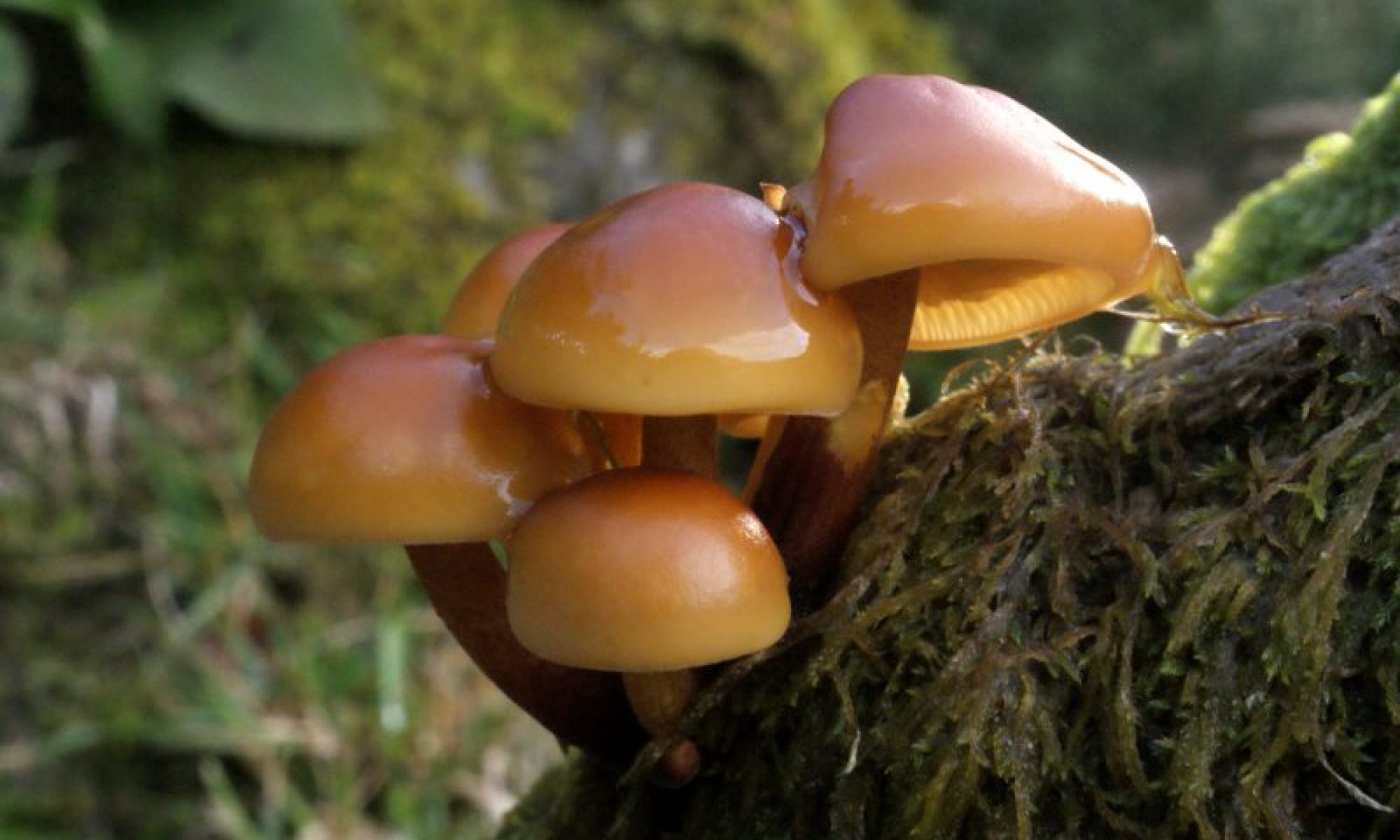
Cuphophyllus aff. fornicatus
Yet again, an odd find from the Curragh. I have forward and reverse sequences for this. The sequence is nearest to Cuphophyllus fornicatus but they are clearly different from it and it looks like an undescribed species. Sounding others out, David Harries in Wales has a matching sequence so it has been found elsewhere. Found by Mo Rainey in the military graveyard.
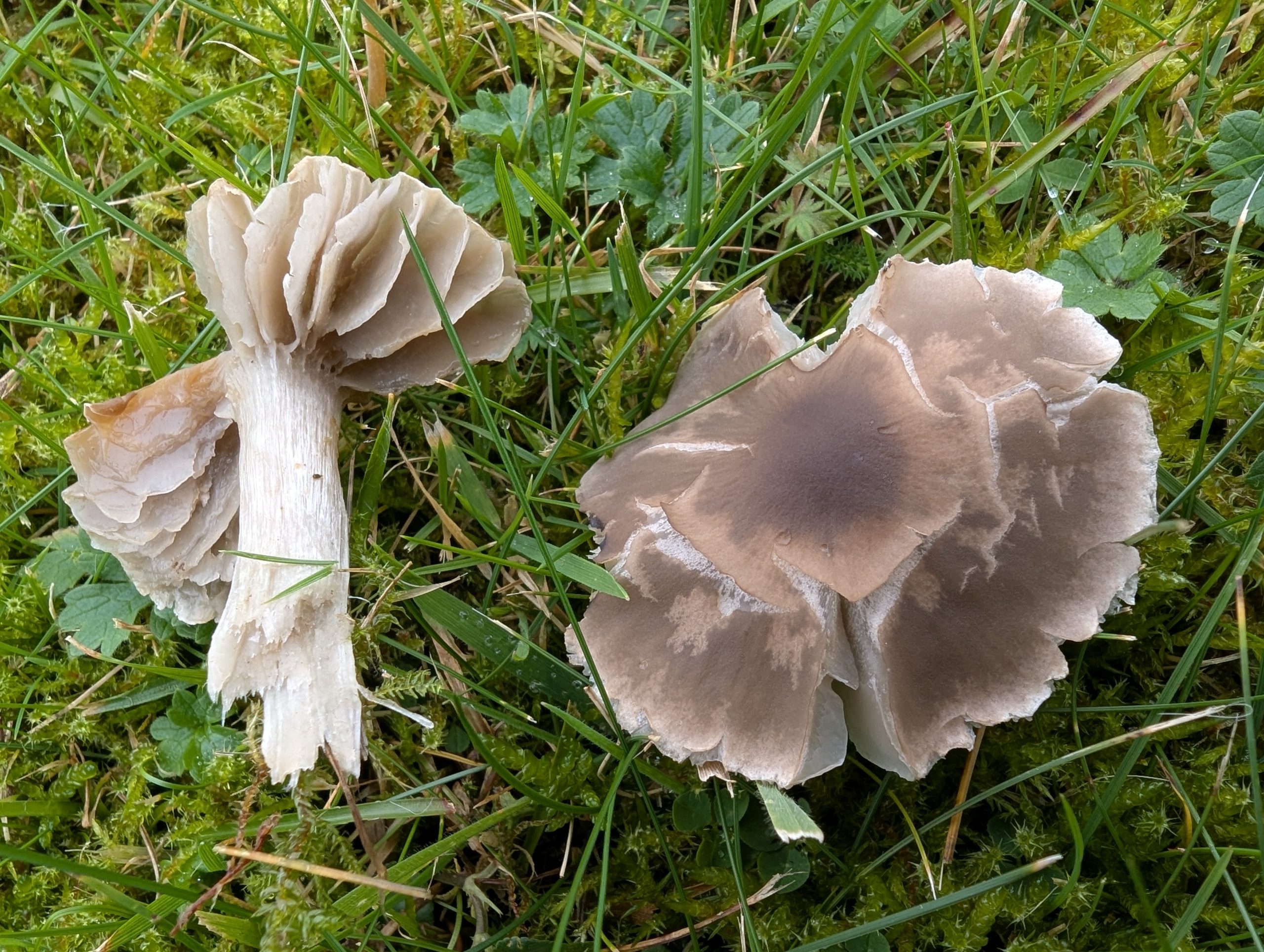
Cuphophyllus aff. fornicatus, The Curragh. Found by Mo Rainey
Cuphophyllus aff. virgineus
A few large white waxcaps that looked like the snowy waxcap but also a bit like C. pratensis var. pallidus. The caps were a bit greasy (after lots of discussion and confirmed under the microscope) but I was wondering if it could be the American C. angustifolius of which there are some possible sequences from Wales. However, the sequences take it to near to C. virgineus. There were two finds from the Curragh and one from the Giant’s Causeway. I found a batch more sequences of this group on iNaturalist from the US but when I draw a phylogenetic tree, the Irish ones cluster with a Welsh and Italian sequence and appear a bit different to an American cluster labelled “aff. borealis” or the Pacific North West Clade 9. Unsure as to where the actual Snowy Waxcap sits in the tree, I collected a “typical” Snowy from the Black Isle and sequenced that and that comes out in a very different group. It is interesting that this cluster is all European and the near by American ones are grouped differently. So not virgineus, not borealis and not var. pallidus. Hence, a potential undescribed taxa. Hopefully David Boertmann’s new book later this year will shed light on this.
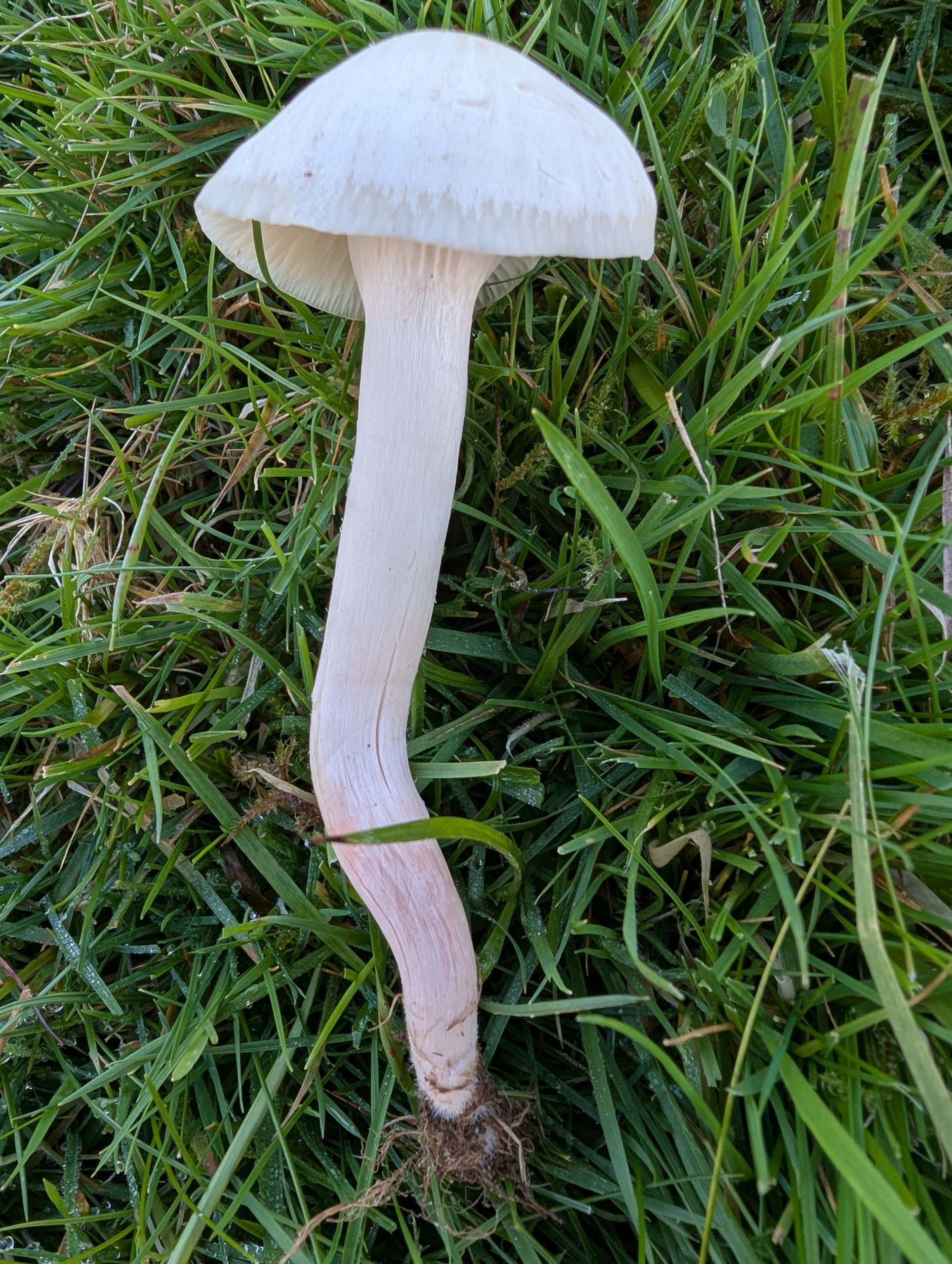
Cuphophyllus aff. virgineus, The Curragh found by Maria Long
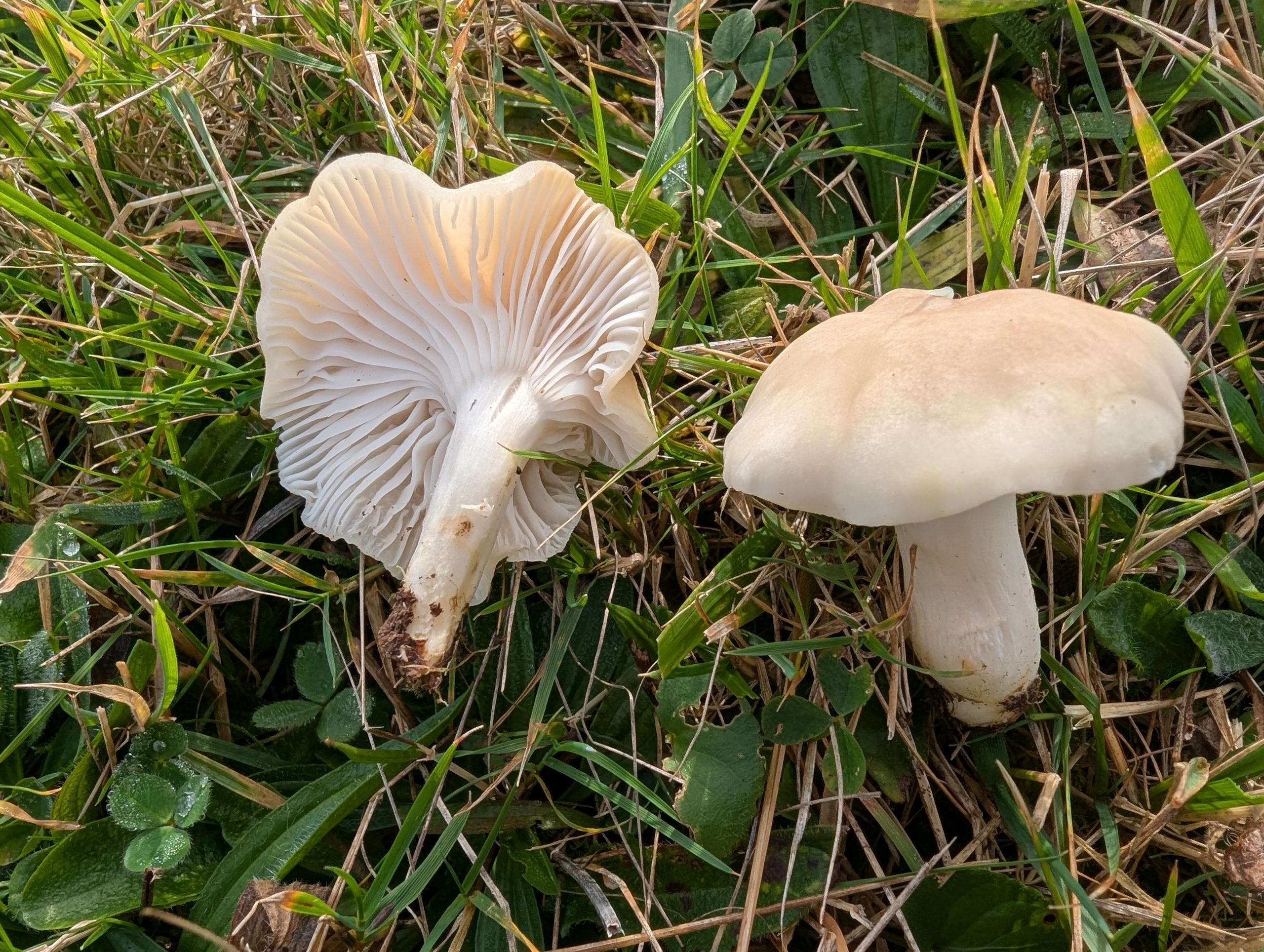
Cuphophyllus aff. virgineus, Giant’s Causeway found by Amy Laird
Cuphophyllus lacmus
The Grey Waxcap. This was found at Smelt Mill Bay in Bangor, Co. Down in exactly the same place as I found it 28 years ago when an over friendly Red Setter obliterated it leaping all over me just as I had photographed it. Found in amongst heather, this species has been found to inhabit the heather root tips on Lundy and here it was, in the same situation maybe forming a mycorrhizal sort of relationship? There are some taxonomic questions about this species as a Canadian paper split Cuphophyllus subviolaceus from C. lacmus so it will be really interesting to see if this is accepted in David Boertmann’s new book when it comes out this year. If they are separate, this is C. subviolaceus as it is in that clade. Interestingly, C. lacmus is supposed to have a rancid taste and this had no taste at all which maybe further points to C. subviolaceus.
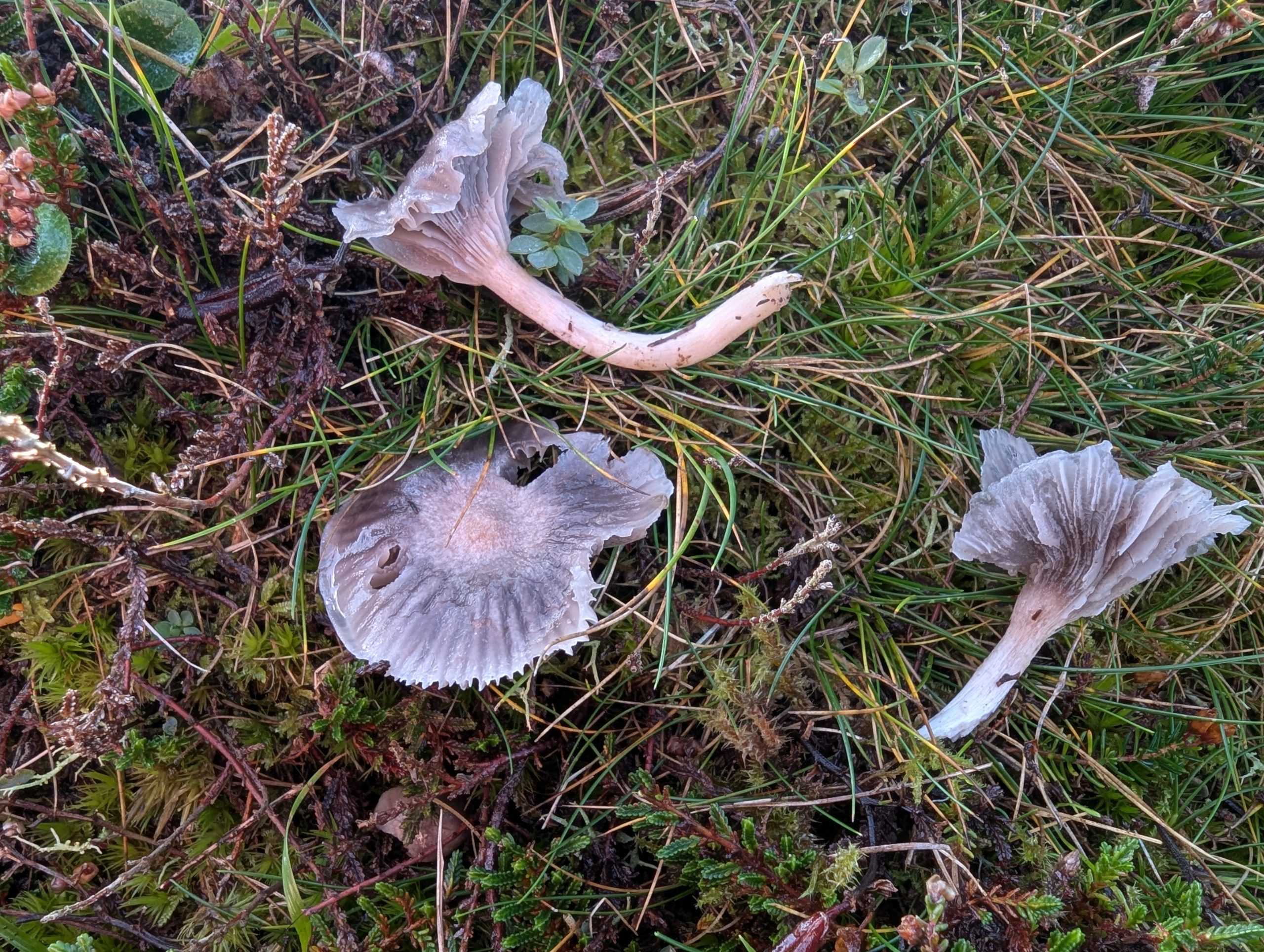
Cuphophyllus lacmus, Bangor, Co. Down
Cuphophyllus radiatus
Two records, one from Tievebulliagh found by Mark Wright on 03/11/2025 and the second from the Giant’s Causeway the following day. These are the first Northern Irish records (it has been found on the Curragh). C. radiatus was in the first edition of David Boertmann’s book but was reduced to a synonym of C. flavipes in the second edition. That was not universally accepted and it remained as a distinct species on the Kew Basidio checklist and, molecularly, they are distinct. The lack of yellow at the base distinguishes from flavipes and the thin fibrillose stipe and the cap having no rancid taste or smell distinguishes from lacmus. The sequence illustrates one of the problems of interpreting sequences as the blast comes out as flavipes but sequences were often named based on the latest edition of Boertmann’s book. However, when a phylogenetic tree is drawn from similar sequences, the sequence of radiatus is quite distinct from flavipes.
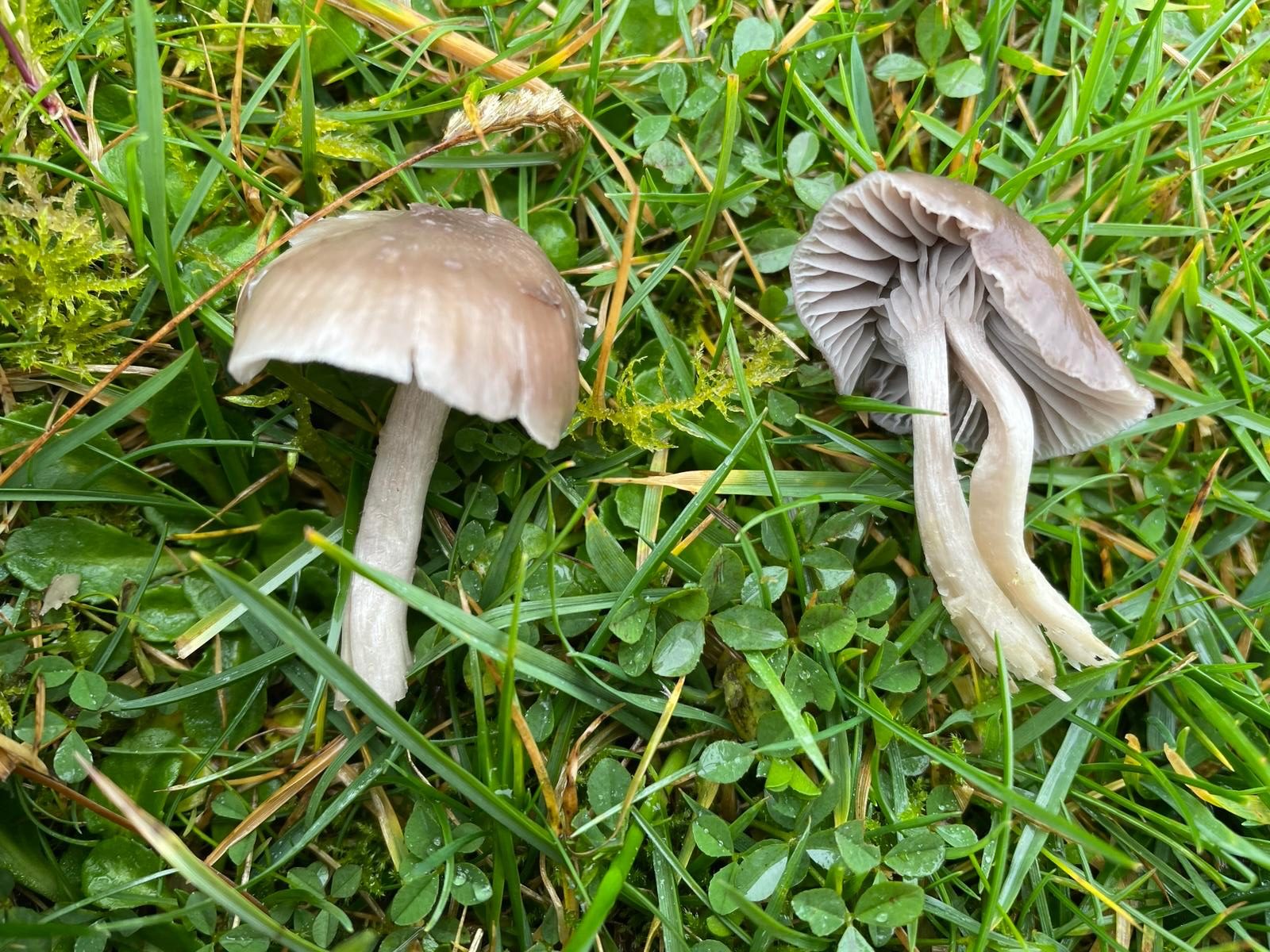
Cuphophyllus radiatus, Tievebulliagh. Photo by Mark Wright
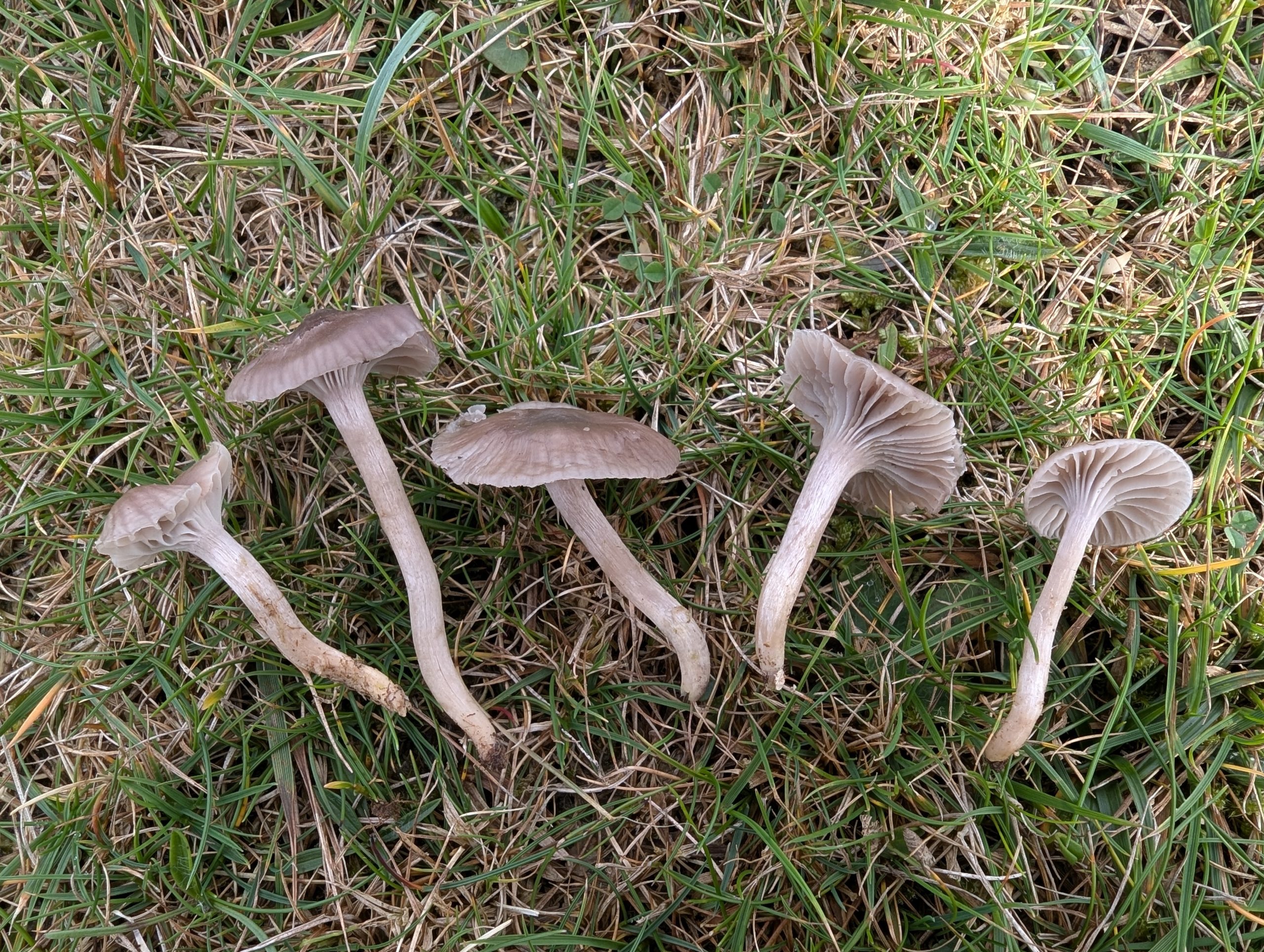
Cuphophyllus radiatus, Giant’s Causeway
Gloioxanthomyces vitellinus
Always a nice find, this was found at Cushleake Mountain (Sluggan Burn), Glendun Hill Farm and Ward Park in Bangor (Maia Taylor). A small delicate waxcap, it is very lemon yellow with the key ID feature being a viscid, almost transparent, gill edge.
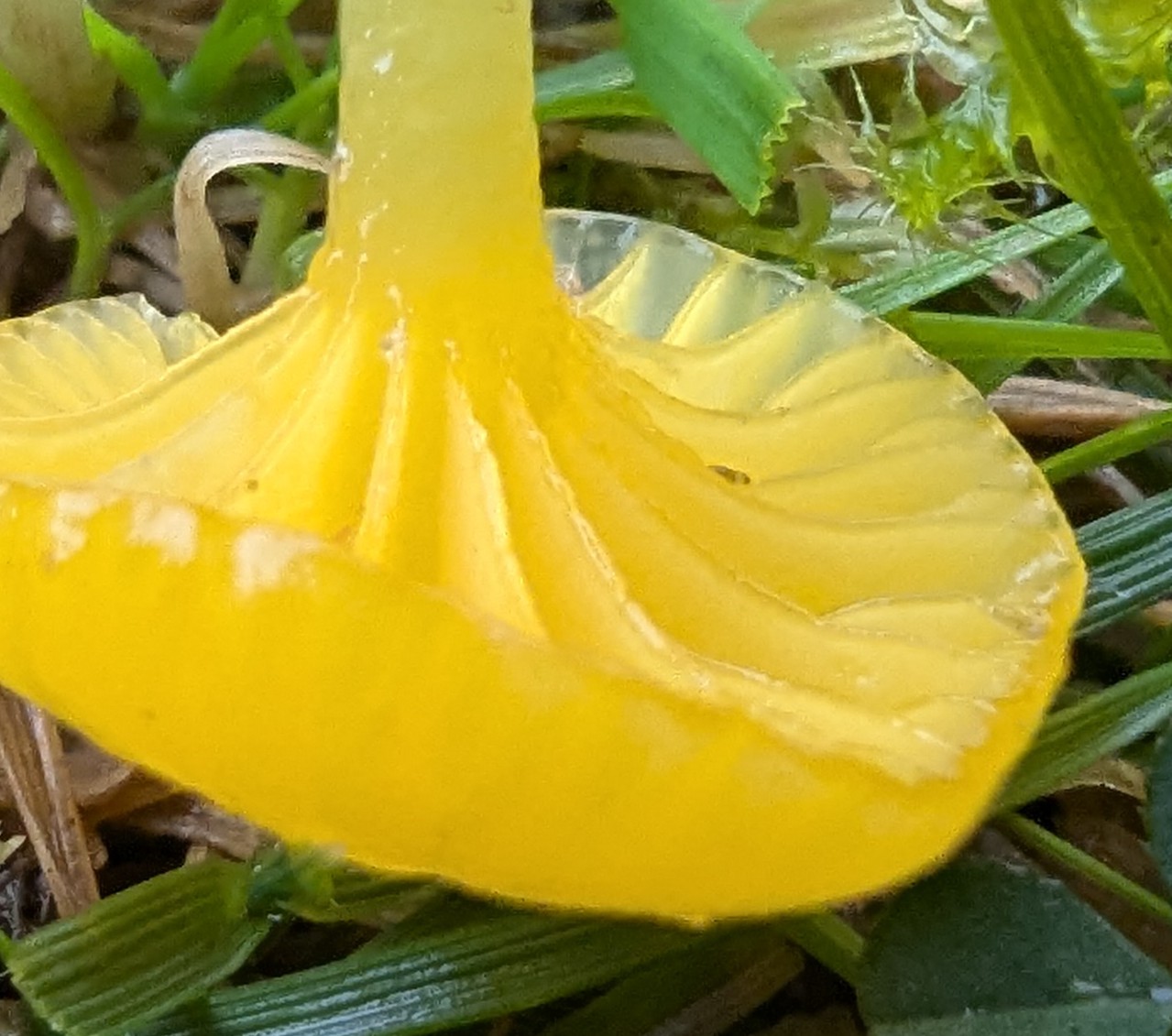
Gloioxanthomyces vitellinus, Cushleake Mountain
Hygrocybe insipida complex
This was one of the target groups to look at this year as Tomas Milan had found and sequenced the newly described Hygrocybe garajonayensis from the Curragh. So we were curious to find out how this common this was compared to insipida. However this turned out to be much more complicated than expected and of 13 sequences, there was only one that matched the sequence labelled as insipida in the papers describing aurantiocitrina and garajonayensis but that may actually not be insipida. The type of insipida has not been sequenced so we don’t know what it is and my money is on aurantiocitrina, the most commonly found sequence in this survey, being the actual insipida but we’ll have to wait in naming any of these finds until this complex is properly worked out. The one insipida sequence I did get, looked quite unlike what I would have called insipida!
Hygrocybe cf. aurantiocitrina: 6 finds from Cushleake Mountain, Altnahinch Dam, Giant’s Causeway in Antrim, Binevenagh and two from the Curragh.
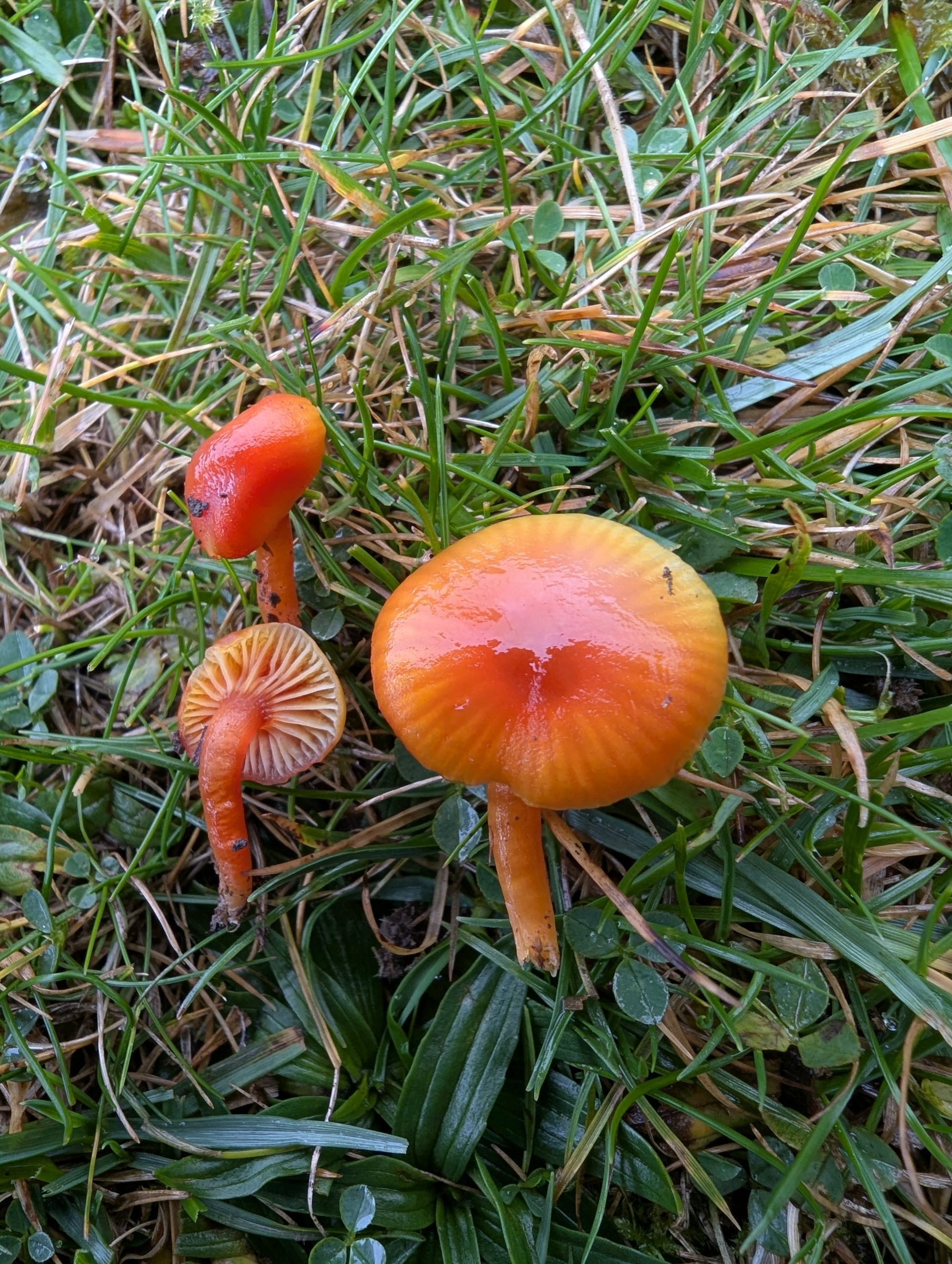
Hygrocybe cf. aurantiocitrina looking very like what I have always called insipida. Red capped, very greasy on cap and stipe and almost difficult to hold.
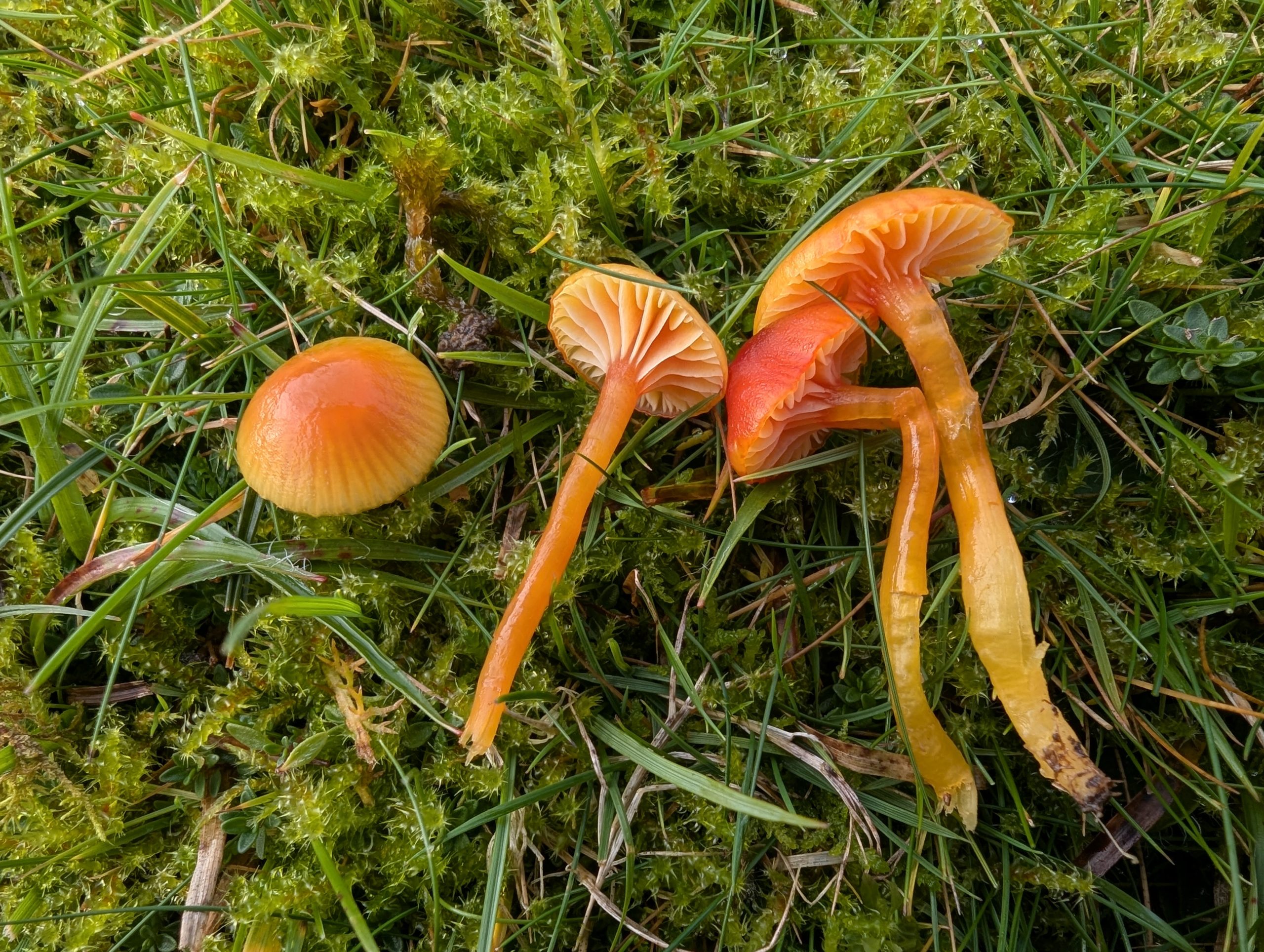
Hygrocybe cf. aurantiocitrina, The Curragh
Hygrocybe garajonayensis: 3 finds – from the Giant’s Causeway, Cloughey Dunes (Roy Anderson) and Gortnagory.
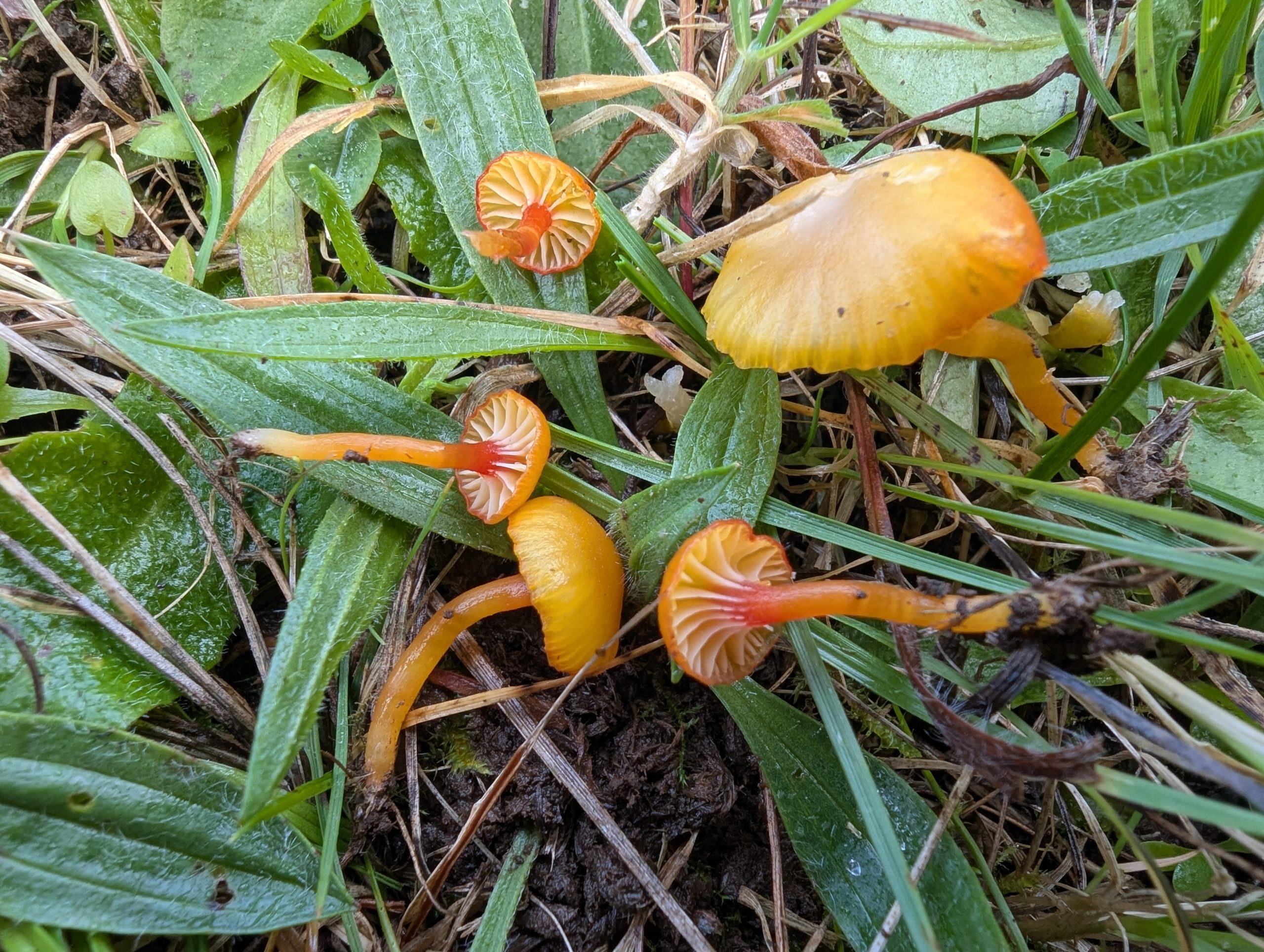
Hygrocybe garajonayensis, Giant’s Causeway. The red just at the stipe apex and markedly decurrent gills may be important features
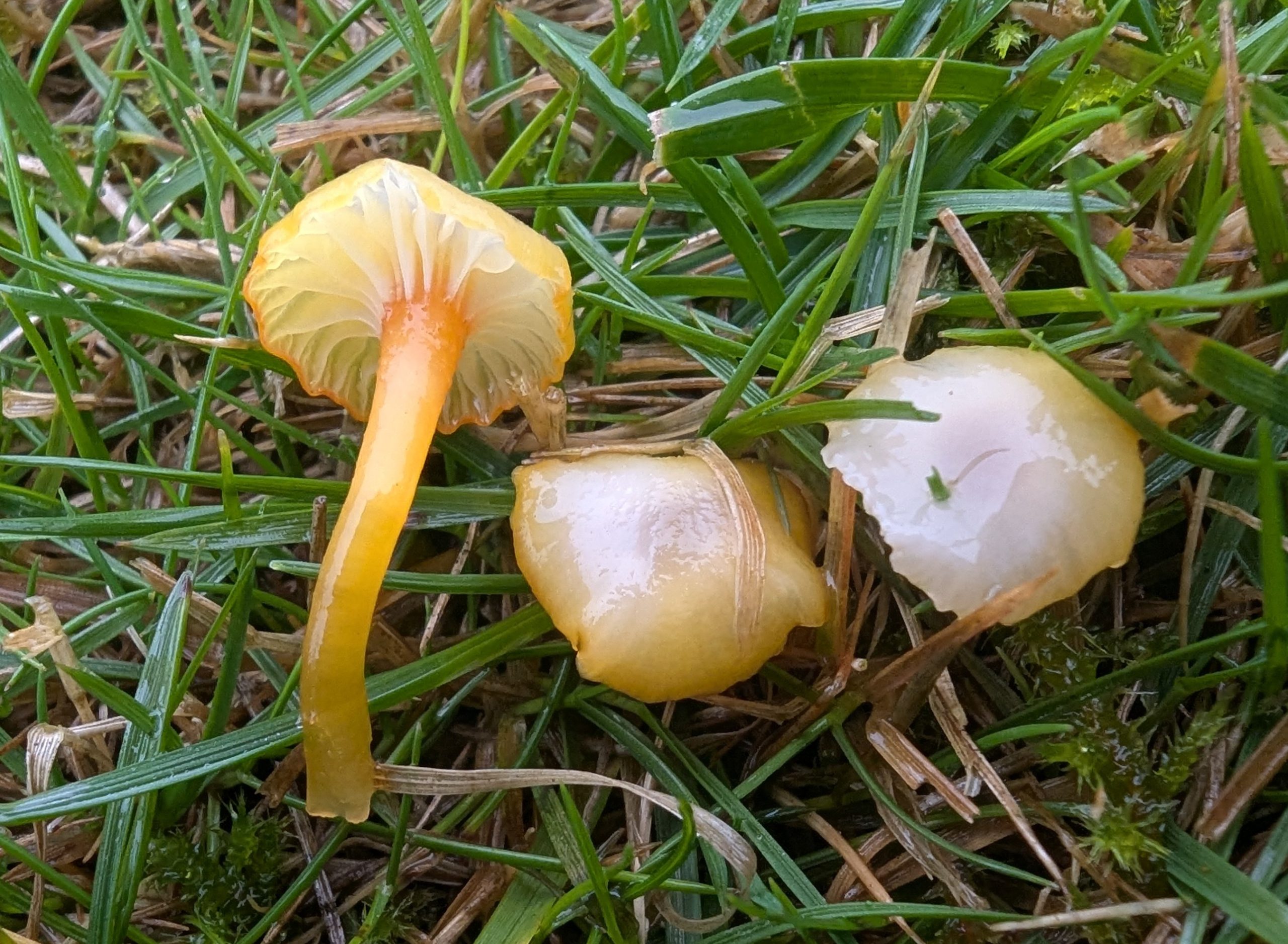
Hygrocybe garajonayensis, Gortnagory – quite washed out in the rain
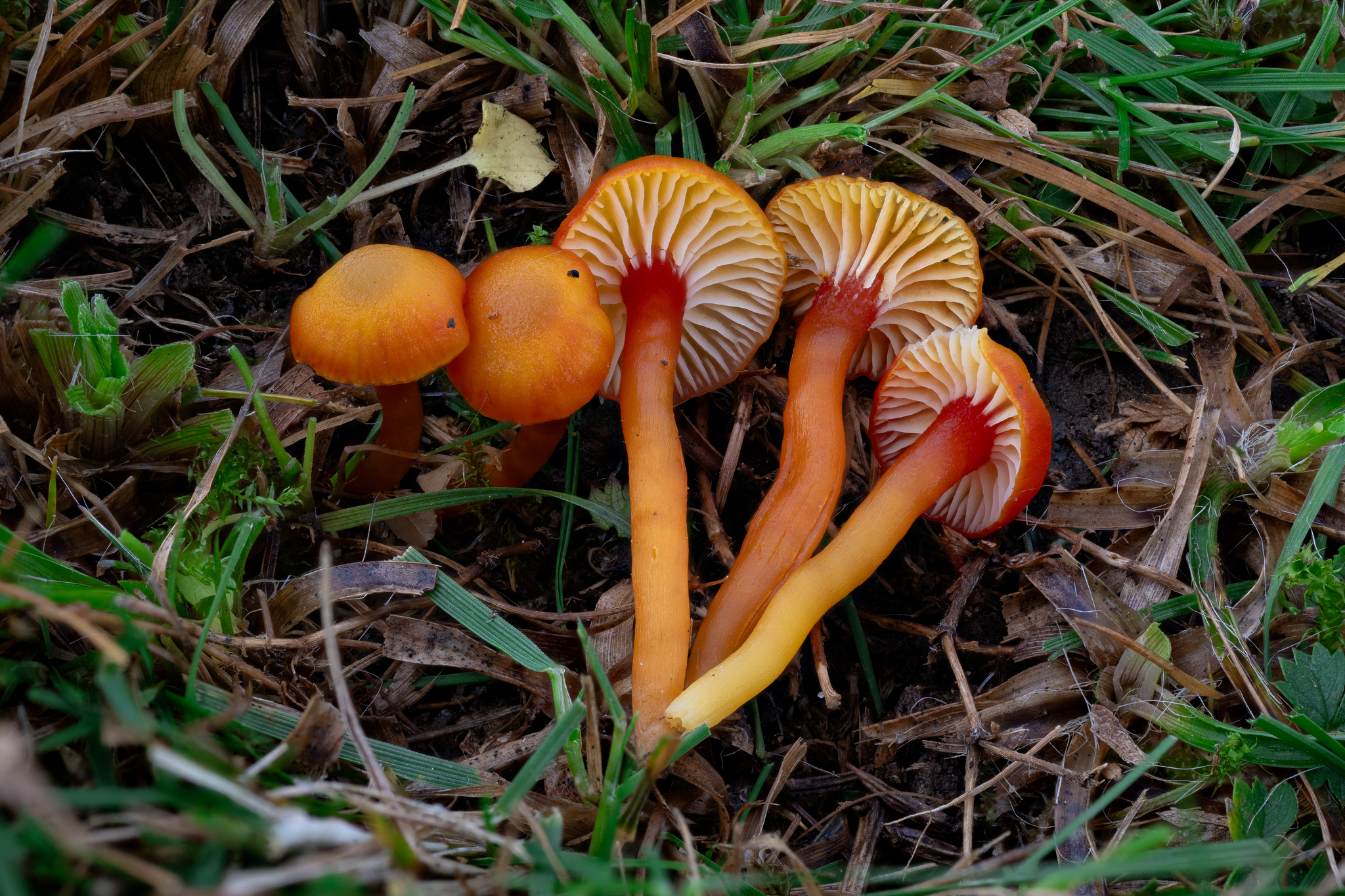
Hygrocybe garajonayenis, The Curragh. Photo by Tomas Milan
Hygrocybe cf. parvula: This is an American species so far not known in Europe so if it is correct, these are very interesting records!! Both found at Glendun Hill Farm by Chris Stretch and myself. Typically parvula has a yellow cap with a red or orange stipe and everything fits macro and microscopically. There is no type sequence for parvula but there are sequences from the type locality and these Glendun sequences are about a 99.3% match to those but ideally it would be closer. One to keep a watch on.
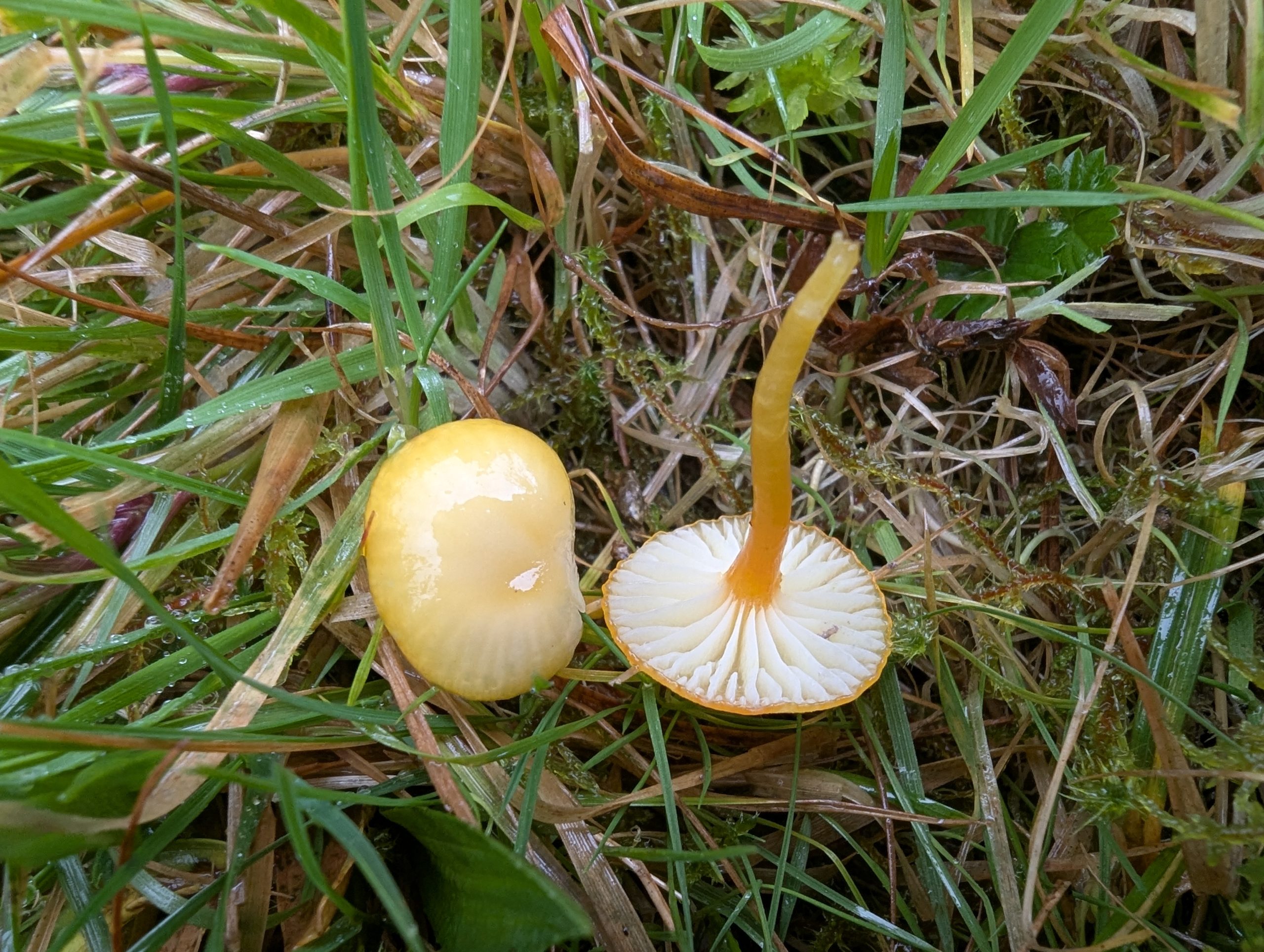
Hygrocybe cf. parvula, Glendun Hill Farm, Antrim
Hygrocybe aff. constrictospora: Found at the Giant’s Causeway in the hay meadow field near the upper car park by Simeon Cathcart. It is near to H. constrictospora but is not it. H. constrictospora has a dry cap, broadly adnate to decurrent gills and with over 70% of the spores with a constricted middle. These spores were 7-9.5 x 3.5-5µm so way too large for insipida but the amount of constricted spores was more like 40%. The cap is greasy so different from constrictospora.
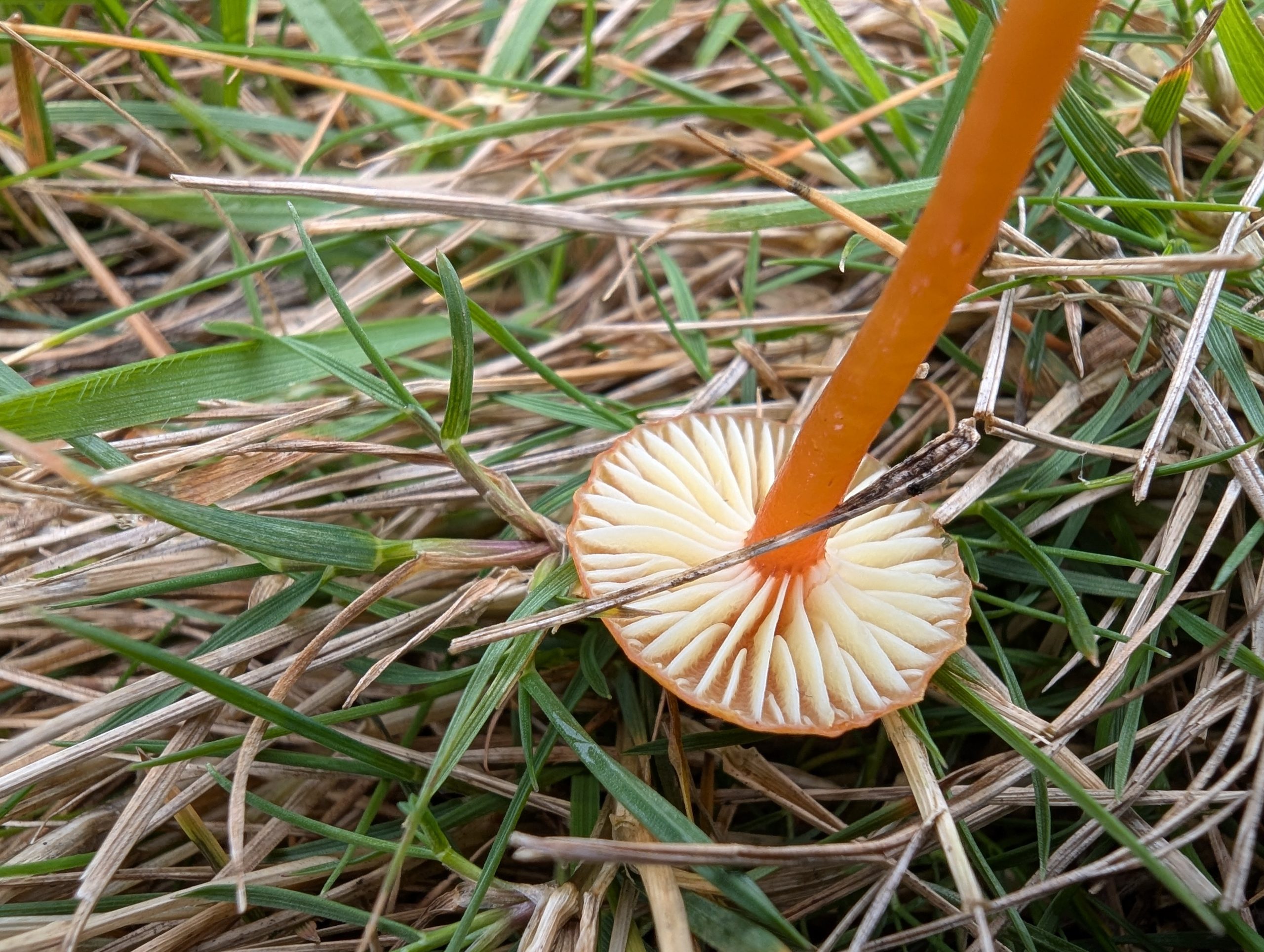
Hygrocybe aff. constrictospora, Giant’s Causeway
Hygrocybe cf. insipida
Given all the above, all our non-sequenced records are probably going to have to go down as Hygrocybe insipida s. lat. This one sequence clustered with what the papers describing H. garajonayensis and H. aurantiocitrina as H. insipida but as explained, we don’t know if it was actually insipida. This one was found at Layde Parish Church in Cushendall but looks very different to what I would normally call insipida…..
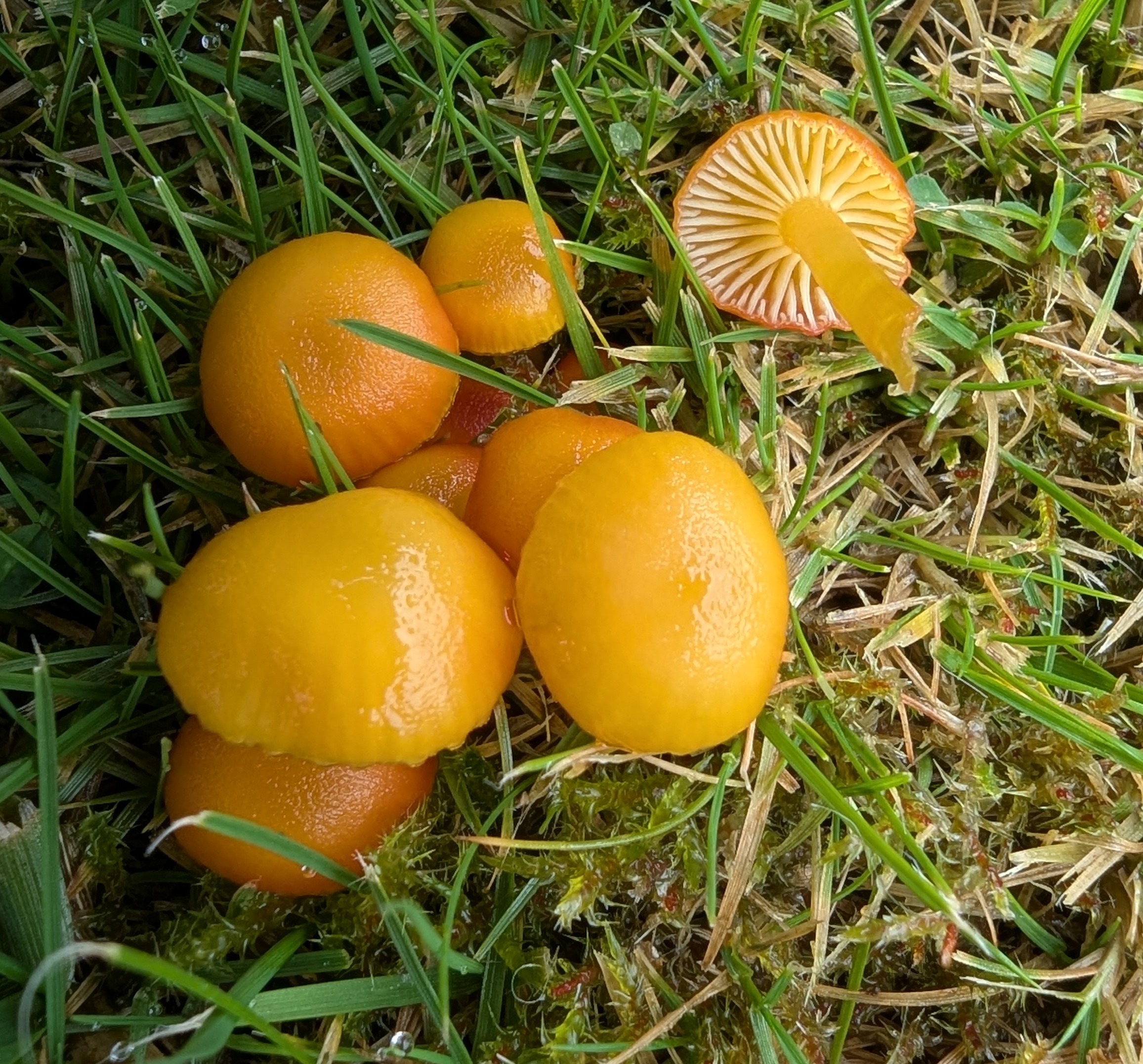
Hygrocybe cf. insipida, Cushendall
Hygrocybe aff. quieta
Another “aff”. Found at Ballycoos Hill by Jolanda Smit. The slightly purple colours made me thing it was a possible Gliophorus reginae but the sequence took it to near to an aurantiosplendens from a specimen held at Kew and some quieta sequences. Martyn Ainsworth of Kew mentioned that they were working on a paper looking at the aurantiosplendens area (I didn’t even realise there were cryptic species in that group….) so I sent him this sequence and it comes out identical to a find that was sent into Kew from the Brecon Beacons that is close to quieta but that had purple even on the gills. This could get worked up into a new species but the Ballycoos specimen had seen better days and it would be really good to get a fresh specimen so if anyone wants to look, I have the exact coordinates and it is not far from the road at all!!
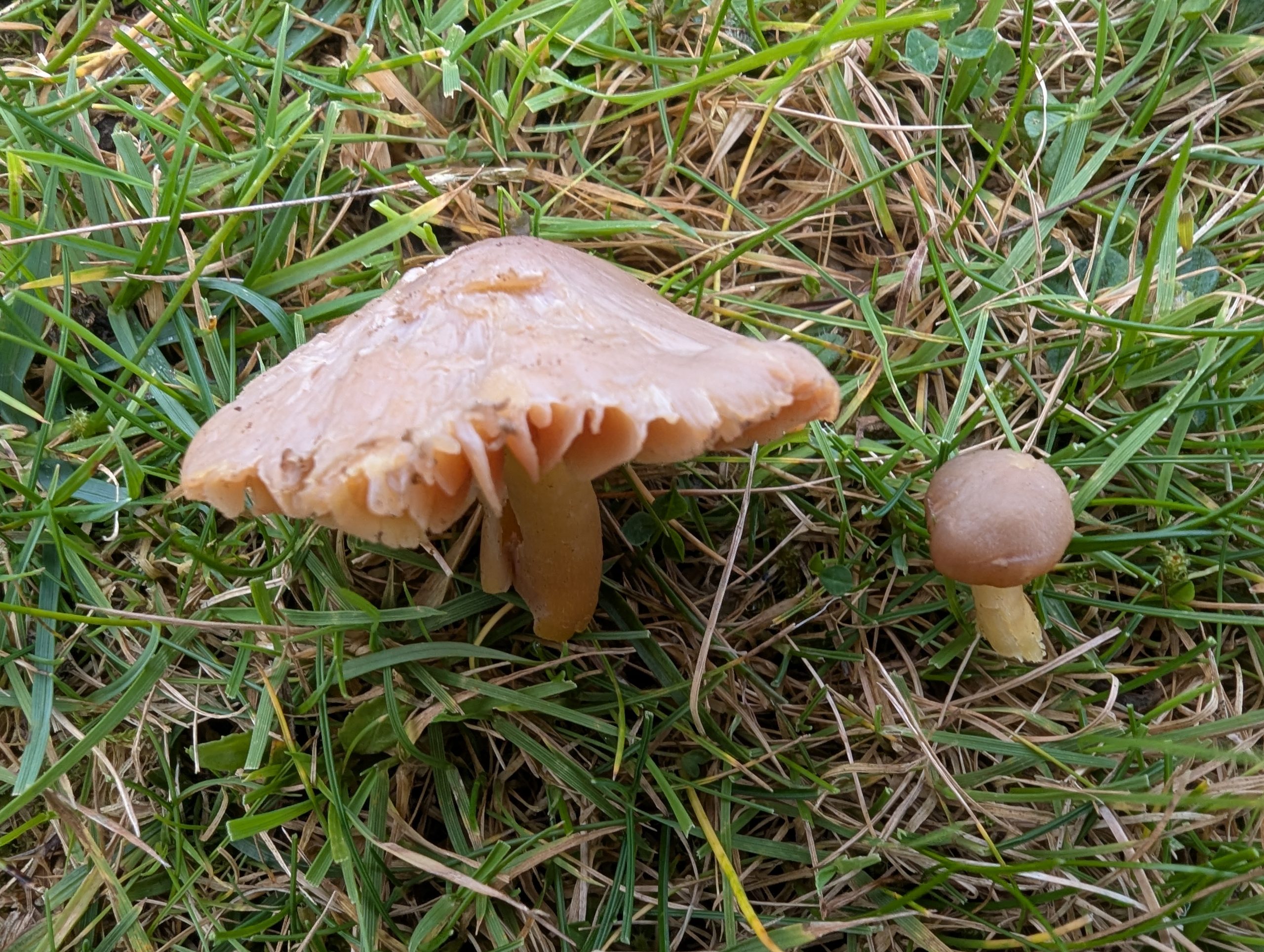
Hygrocybe aff. quieta
Hygrocybe coccineocrenata
This one was found at the Giant’s Causeway by Jolanda in one of the fields right beside the cliff path directly north of the upper car park. Thus definitely not a bog which is the habitat that H. coccineocrenata is supposedly restricted to. Also found at Gortnagory. The spores are too large for H. lepida.
H. coccineocrenata sequences appear all through the tree sometimes mixed with ones for turunda so there is confusion about these concepts and it really is a case of waiting for the new edition of David Boertmann’sw book and definitive sequences of these species. The habitat would maybe fit turunda better but the phylogenetic tree, for what it is worth, suggests coccineocrenata. As with the Gortnagory find, the distinctive black squamules were not obvious. I can sort of see them now in the photo but they didn’t jump out in the field. H. coccineocrenata is not a JNCC scoring species for grassland fungi as it was thought not to be in grasslands but I am wondering if that actually holds….
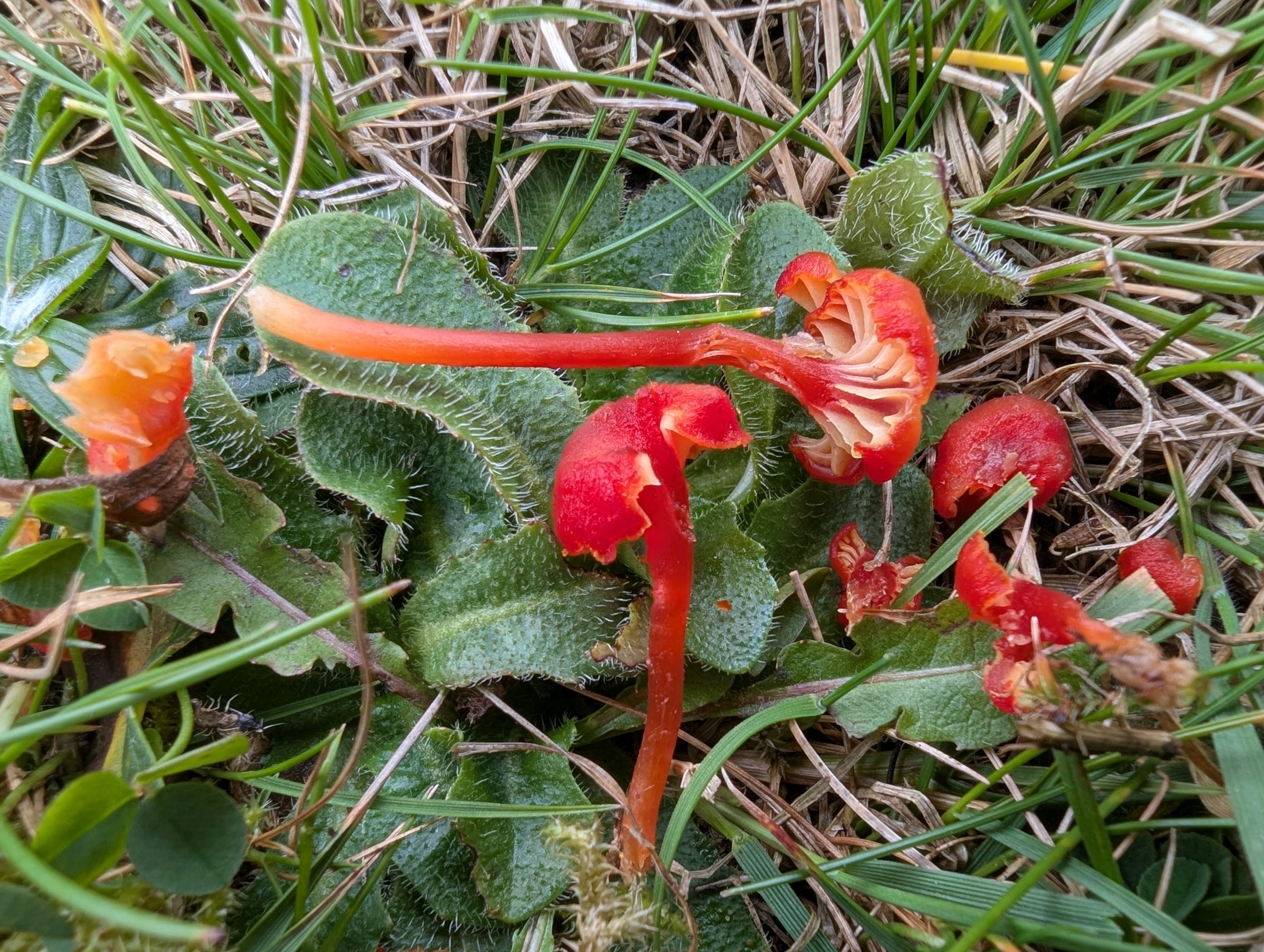
Hygrocybe coccineocrenata, Giant’s Causeway
Hygrocybe phaeococcinea
Two nice sequences but with another curious result. There is one very close match (99.58%) to a Kew sequence of phaeococcinea, but they are also not near to a lot of other sequences of phaeococcinea (only 97.1% and less). Does that mean that there are actually two species in here? Possibly. Many waxcaps surprisingly need reference sequences or type sequences. In the field, the two were quite different. One was the typical scarlet form with a faint blackish area in the cap centre and one was a bit curious for phaeococcinea being more yellow-orange than red and with no blackening on the cap. David Boertmann does say that this form of phaeococcinea is very rare but, sequence wise, they came out as the same. Found by Simeon Cathcart at Giant’s Causeway.
These were slightly problematic to sequence. Sanger Sequencing can have problems when you get a long string of identical base pairs as it can “slip” and go wonky after this string. These sequences all slipped about 120 base pairs in with a forward sequence but to fix that, you can get a sequence in the other direction and paste them together. As the reverse sequence will be much longer before it slips, it is maybe better to sequence a phaeococcinea in the reverse direction first and then get a forward sequence to improve its quality.
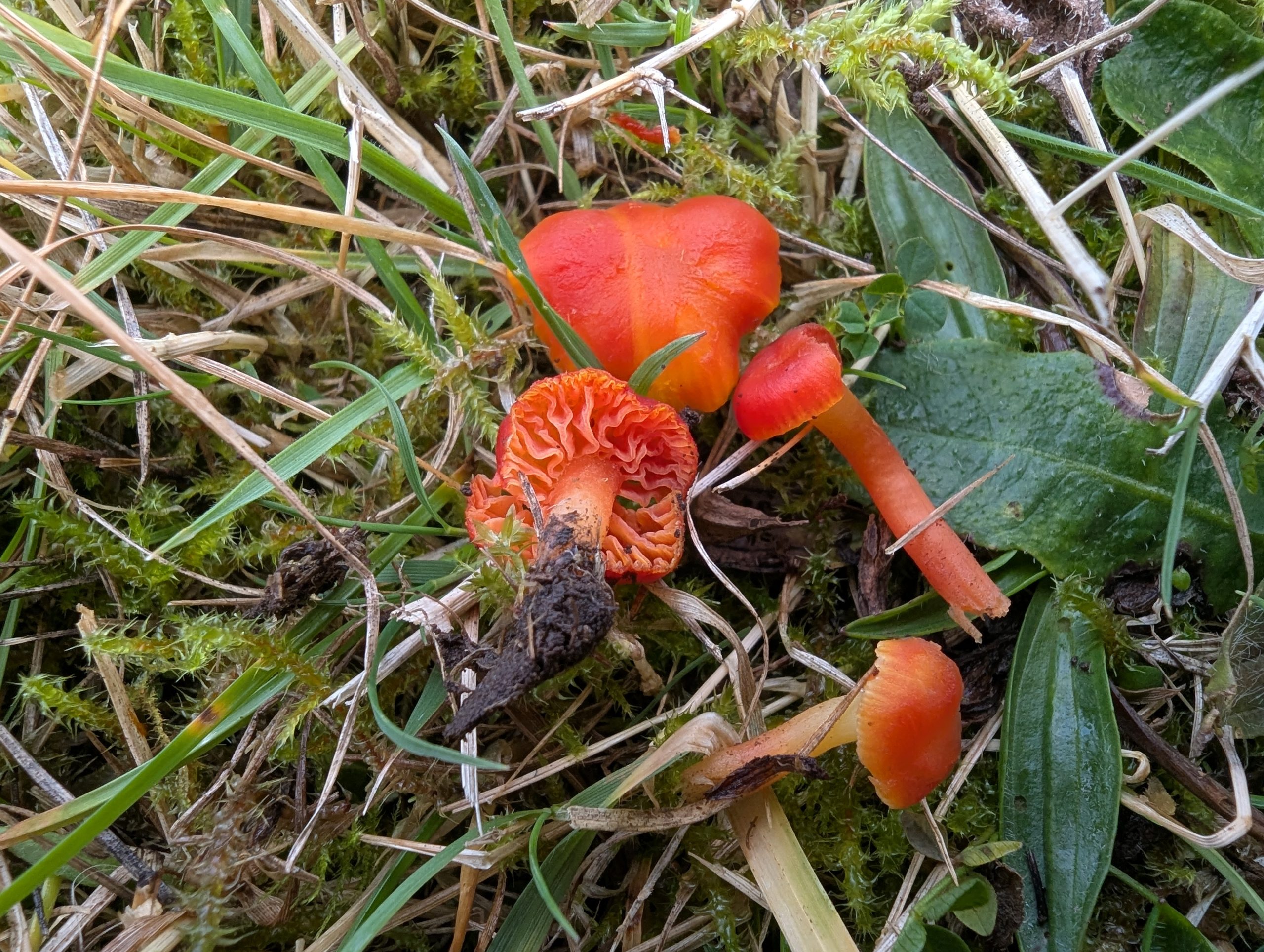
Hygrocybe phaeococcinea, typical form, Giant’s Causeway
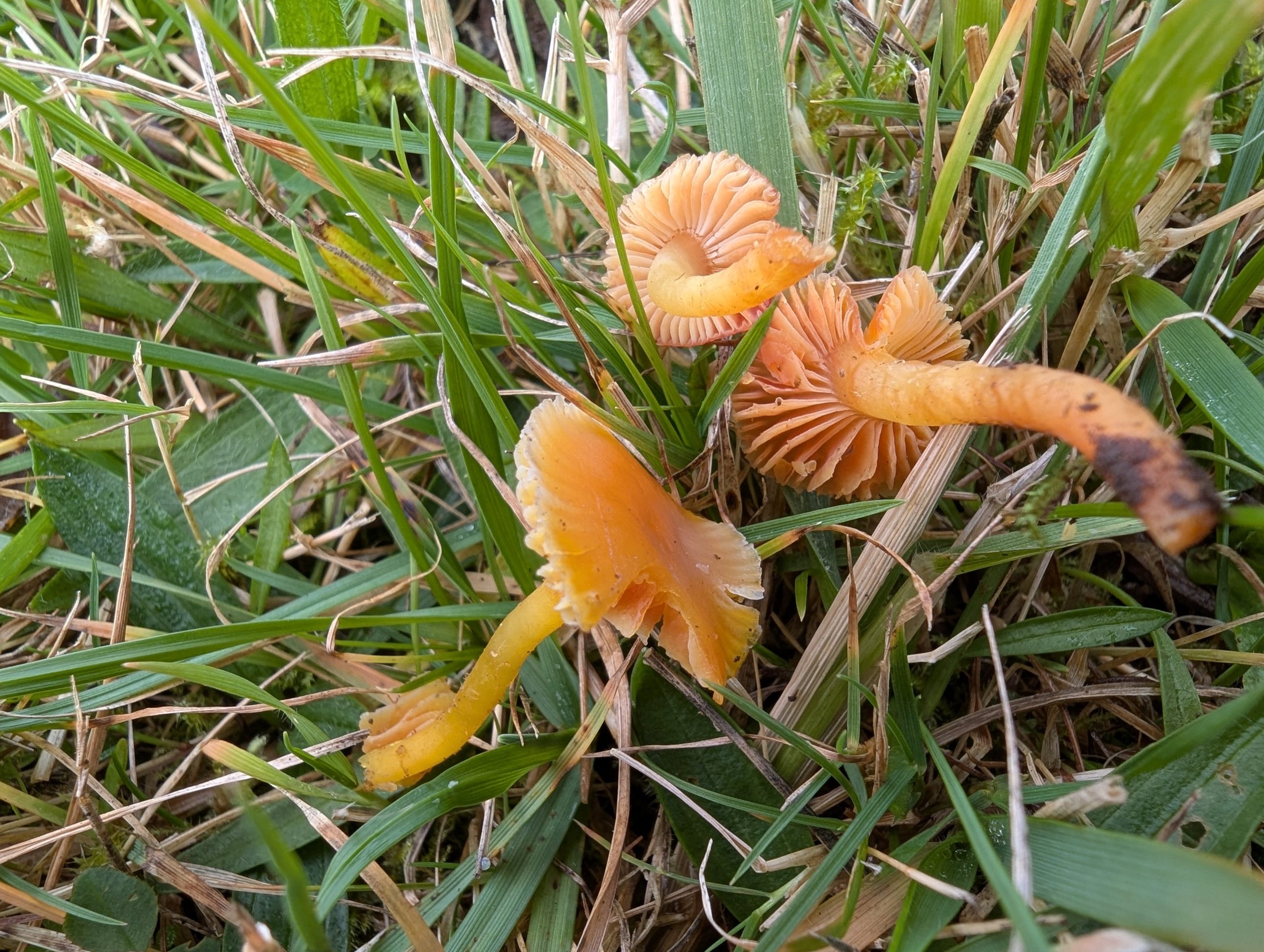
Hygrocybe phaeococcinea, orange form, Giant’s Causeway
Neohygrocybe ingrata
This is a rare species in Ireland with only records from the Curragh and Barnett’s Park in Belfast. So, it was an absolute pleasure to see this at the Curragh. Found by Tomas Milan. It is identified by its chunky fruiting bodies with a dry cao that reddens both on the gills and flesh and having a slightly nitrous smell.
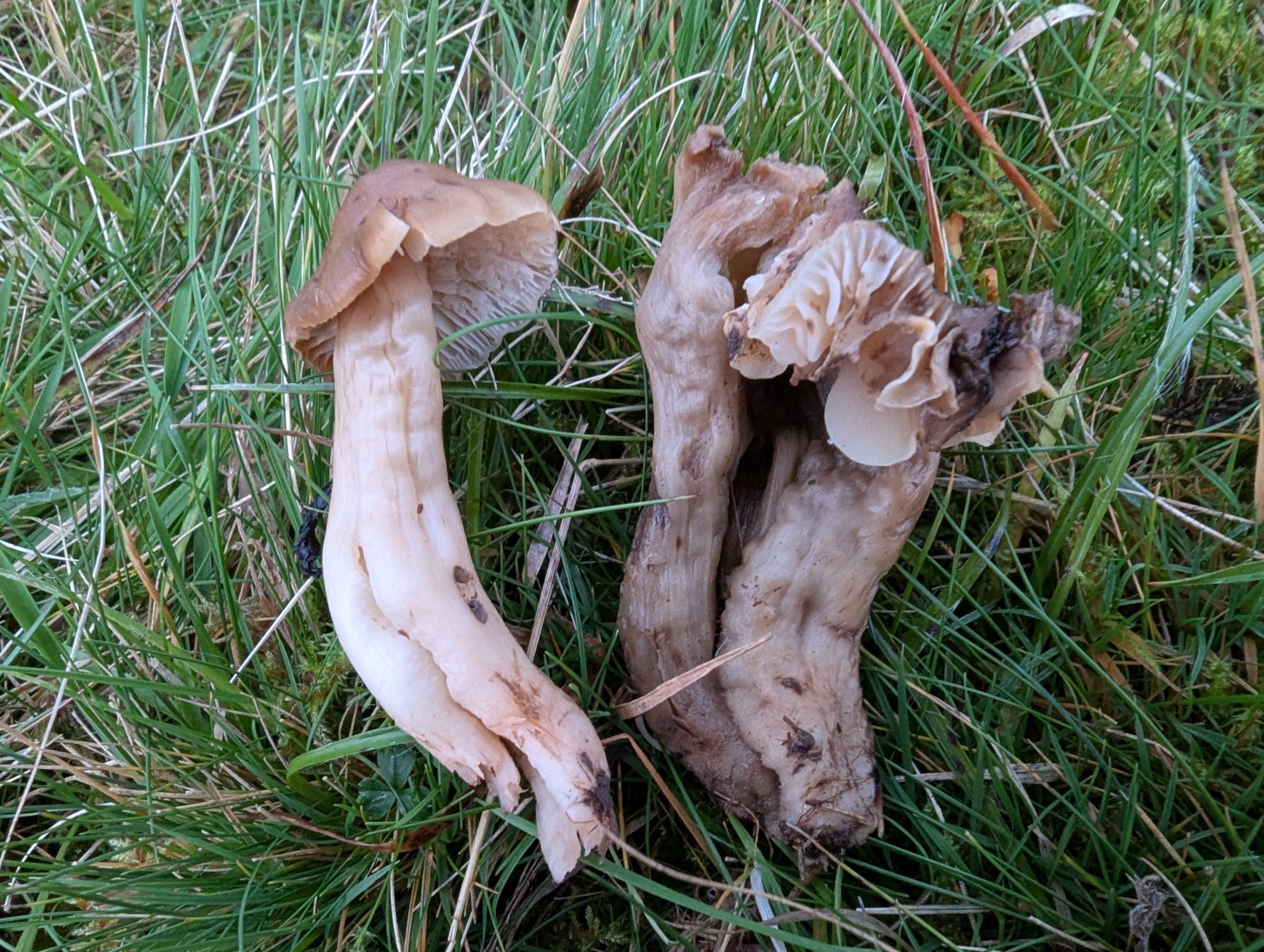
Neohygrocybe ovina
Another of the special waxcaps, this is known from 15 sites in Ireland so only has scattered records. Large and chunky, it can be almost black with very thick gills. It also reddens and can have a nitrous smell like nitrata and ingrata. The cap can be virtually squamulose and is quite different to the other two. This one was found at the Curragh by Tomas Milan but it was also found at Binevenagh.
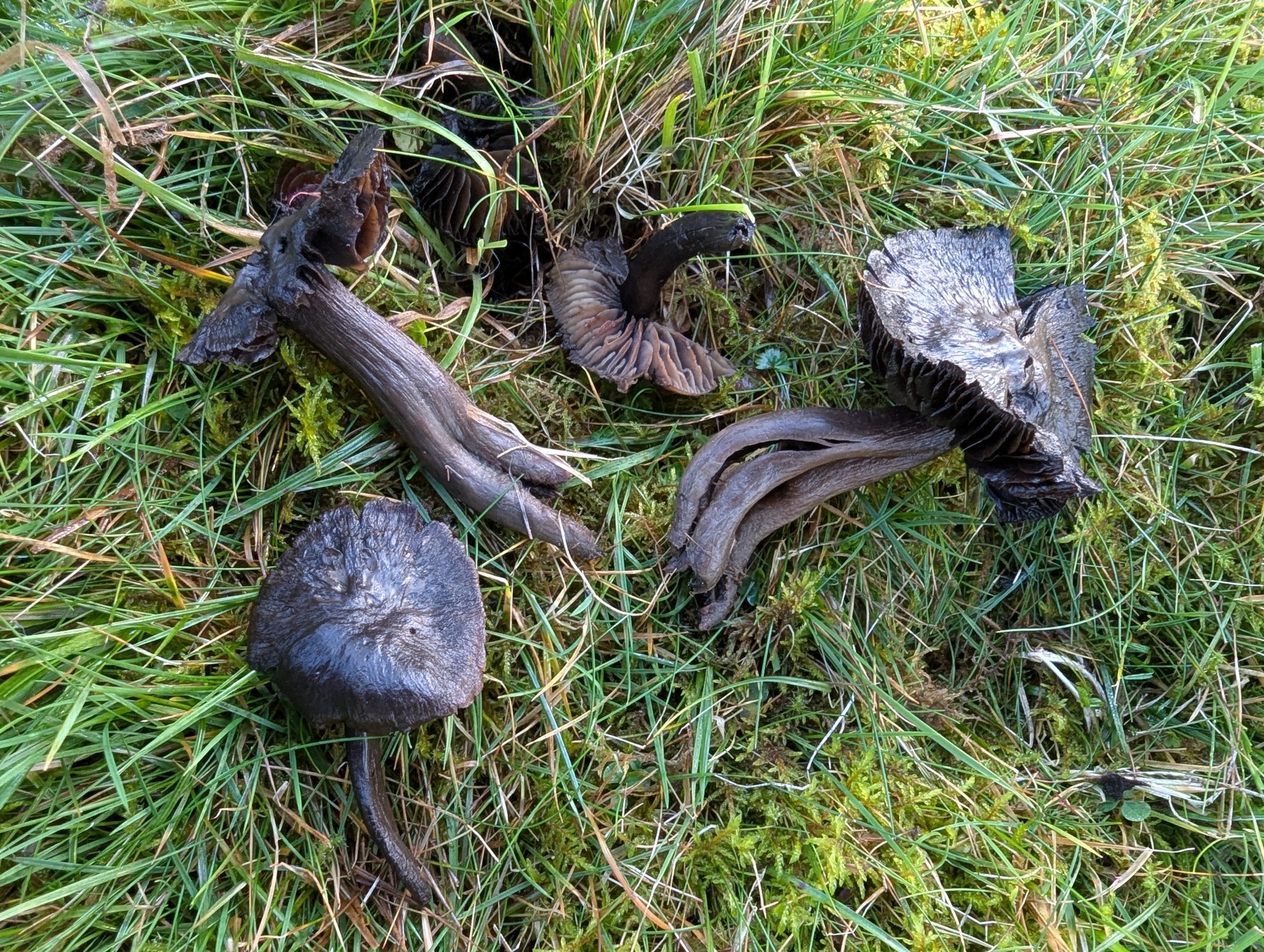
Neohygrocybe ovina, The Curragh. Found by Tomas Milan
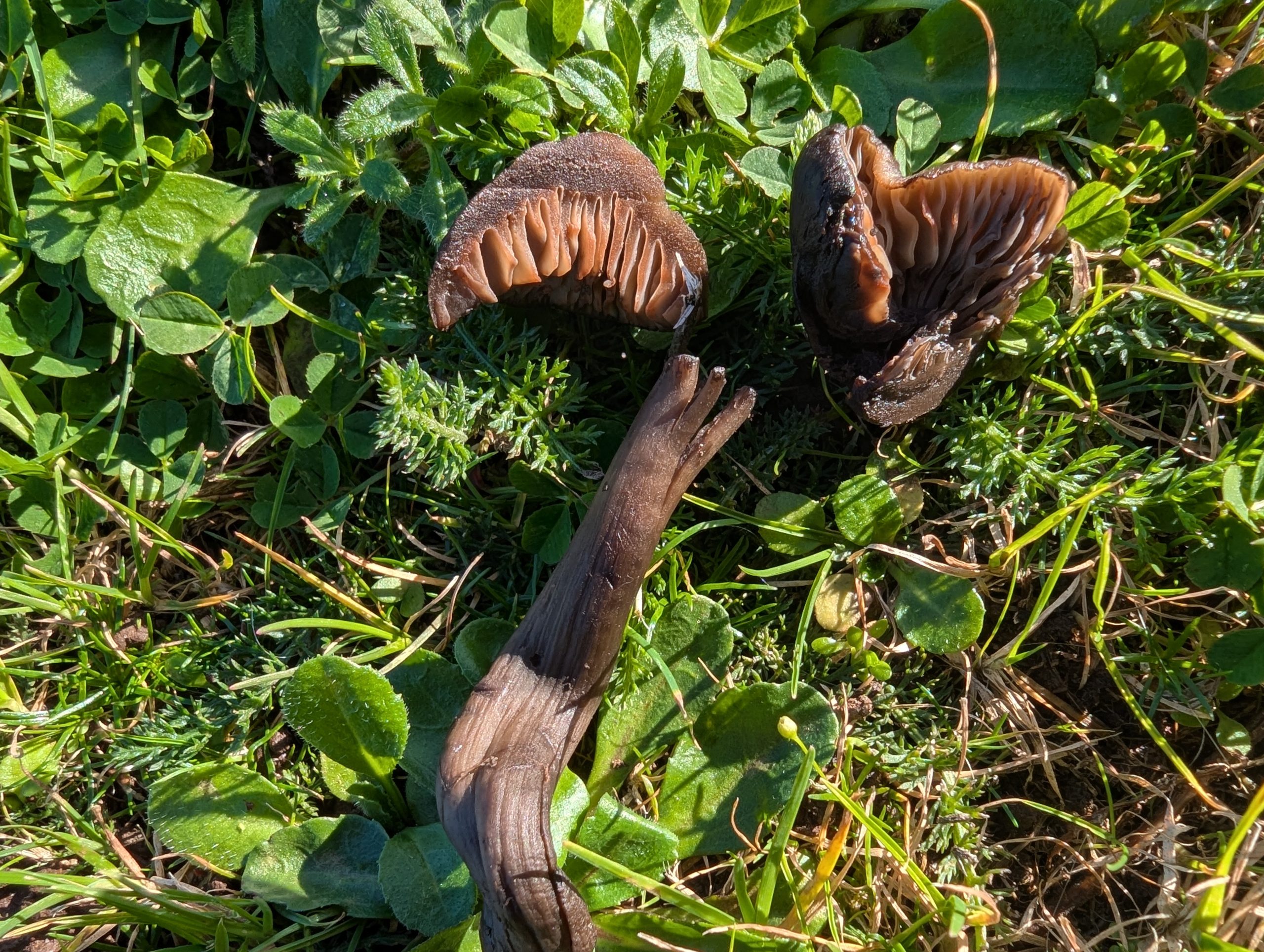
Neohygrocybe ovina, Binevenagh showing the reddening gills